

Politics
Congress tried to give U.S. servicemember protections to people who served in the Israeli military.
Audio edition
A bill in the 118th Congress would have routed IDF service by U.S. citizens into U.S. servicemember protections. The bill failed — but the text survived.
H.R. 8445 did not pass.
That is not the story.
The story is that Congress introduced a bill that would have allowed American citizens serving in the Israeli Defense Forces to trigger legal protections built for Americans serving in the United States uniformed services.
That is not a symbolic gesture.
That is a legal bridge.
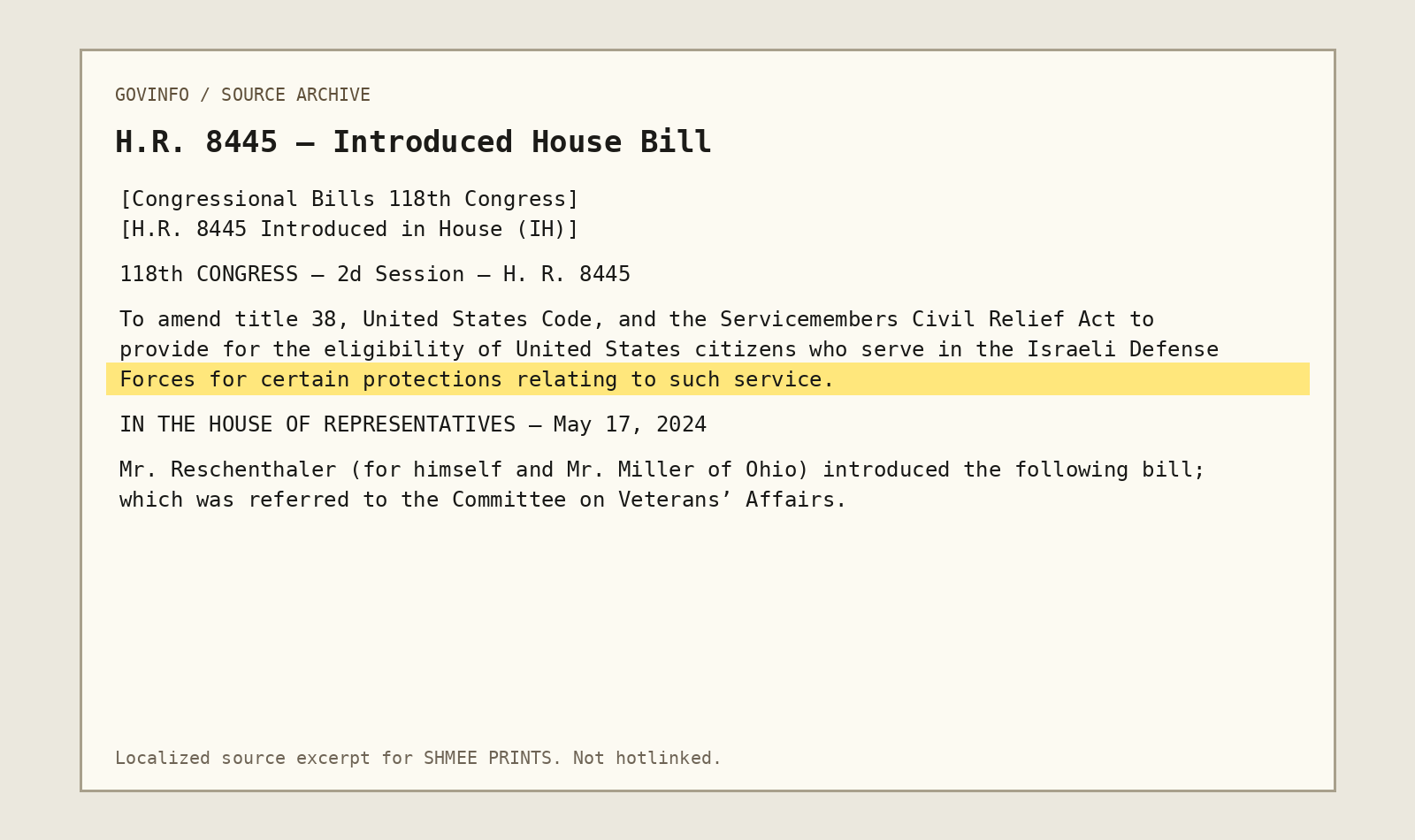
*GovInfo H.R. 8445 cover/title page. The bill failed. The proposed legal bridge is still in the text.*
THE TIMELINE
H.R. 8445 is introduced in the House by Rep. Guy Reschenthaler; Rep. Max Miller cosponsors.
GovInfo records the bill as introduced and referred to the House Committee on Veterans’ Affairs.
Sponsor press release frames protections for Americans serving in the IDF.
The release says H.R. 8445 would extend SCRA and USERRA protections to American citizens serving in the IDF and claims "over 20,000 American citizens" were serving in Israel.
Referred to Subcommittee on Economic Opportunity.
The House FloorCast record lists H.R. 8445 as referred to the Subcommittee on Economic Opportunity.
118th Congress ends; H.R. 8445 expires.
The Congressional Record refers to the "last gavel" and the journals being sealed and archived; the bill did not become law before the session ended.
WHAT THE BILL WOULD HAVE DONE / WOULD NOT HAVE DONE
What it would have done
- Extended USERRA-style employment and reemployment protections to U.S. citizens serving in the IDF.
- Extended SCRA-style civil and financial protections to U.S. citizens serving in the IDF.
- Treated IDF service, “to the extent practicable,” like U.S. uniformed service for parts of Title 38.
- Named one foreign military directly: the Israeli Defense Forces.
- Pulled American employers, creditors, landlords, courts, and civilian institutions into the consequences of a U.S. citizen’s service in a foreign army.
What it would not have done
- It did not pass.
- It did not create full VA veteran status.
- It did not create VA disability compensation.
- It did not create VA pensions.
- It did not apply neutrally to all allied foreign militaries.
- It did not name Ukraine, Taiwan, Britain, France, NATO forces, or foreign service generally.
That distinction matters.
The bill did not go as far as some claims suggest.
It went far enough.
CLAIMS ON THE RECORD
The uploaded draft frames H.R. 8445 as a quiet attempt to treat IDF service by American citizens as legally comparable to U.S. uniformed service for certain protections. That is the central claim, and the bill text supports the narrow version of it.
The bill’s full title says it would amend Title 38 and the Servicemembers Civil Relief Act to provide eligibility for U.S. citizens who serve in the Israeli Defense Forces for certain protections relating to that service.
The bill did not create a general “foreign allied service” category.
It named the IDF.
That is the pressure point.
Not “support for Americans abroad.”
Not “veterans benefits.”
A targeted statutory exception for one foreign military.
WHAT HAPPENED
H.R. 8445 was presented as protection.
The sponsor’s press release said Americans serving in Israel should receive SCRA and USERRA protections, and it framed them as Americans “defending Israel” and “fighting for freedom.”
But the legal mechanism matters more than the slogan.
USERRA protects employment and reemployment rights for people who leave civilian work to perform service in the uniformed services. The Department of Labor says returning service members must be reemployed in the position they would have attained if they had not been absent for military service.
SCRA protects servicemembers in civil and financial matters. DOJ lists areas including rental agreements, evictions, installment contracts, credit-card interest, mortgage interest, foreclosure, civil proceedings, leases, insurance, and tax payments.
H.R. 8445 tried to route IDF service into those systems.
That is the move.
Foreign military service would trigger domestic American protections.
Protection for one person becomes obligation for another.
The employer has to deal with it.
The creditor has to deal with it.
The landlord may have to deal with it.
The court may have to deal with it.
That burden is the part hidden inside the soft word “protections.”
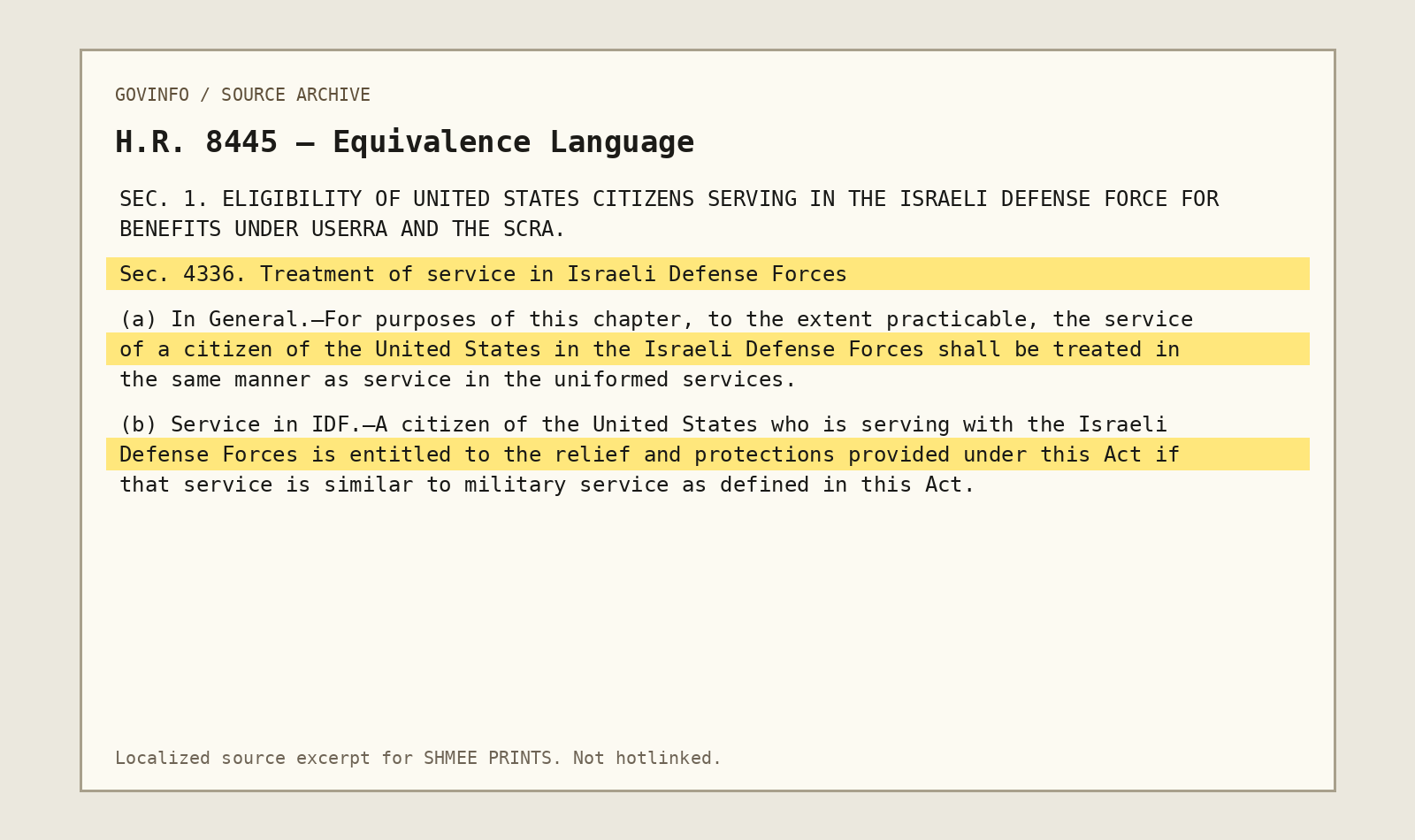
*Highlighted lines from H.R. 8445 showing equivalence language.*
WHY THIS MATTERS
The public framing makes H.R. 8445 sound minor.
The bill text does not.
The SCRA definition starts with U.S. uniformed service. The U.S. Code defines “servicemember” as a member of the uniformed services as defined in Title 10.
USERRA sits in Title 38, Chapter 43: “Employment and Reemployment Rights of Members of the Uniformed Services.”
H.R. 8445 would have inserted IDF service into those protection systems.
Not by implication.
By text.
“Treatment of service in Israeli Defense Forces.”
That heading is the story.
Congress did not propose a broad rule for Americans serving in foreign militaries.
It proposed a special rule for Americans serving in Israel’s military.
That deserved a hearing.
That deserved a public debate.
That deserved questions about precedent.
Instead, the bill was introduced, referred, sent to subcommittee, and left to expire.
THE PRECEDENT
If IDF service can trigger U.S. servicemember protections, why only IDF service?
Why not Americans serving in Ukraine?
Why not Taiwan?
Why not Britain?
Why not France?
Why not any foreign military receiving U.S. support?
Why not a neutral category for allied forces?
Why one named foreign army?
That is the precedent problem.
H.R. 8445 did not merely ask whether American citizens abroad deserve sympathy.
It asked whether service to a foreign government can activate American legal protections usually tied to service to the United States.
That question should not be handled like a clerical update.
It is a jurisdictional shift.
WHY THIS CHANGES EVERYTHING
H.R. 8445 failed.
But the proposed language remains.
That means the idea entered Congress.
An American citizen serves in a foreign army.
That service is treated like U.S. uniformed service for employment protections.
That service is treated like military service for SCRA protections.
The foreign army is not any ally.
It is the IDF.
The domestic costs do not stay with Israel.
They move into American legal systems.
Employers.
Banks.
Landlords.
Courts.
Civil proceedings.
Debt.
Mortgages.
Reemployment.
That is not “minor.”
That is a transfer of obligation.
The sponsors called it support.
The text shows the machinery.
THE PATTERN HARDENS
First, a foreign war creates a sympathetic group of American citizens serving abroad.
Second, Congress frames the issue as protection.
Third, the bill avoids creating a new foreign-service law and instead inserts IDF service into existing U.S. military-protection systems.
Fourth, the bill names one foreign military.
Fifth, the bill dies without a public national debate.
Sixth, the draft remains available for the next attempt.
That is the pattern.
Not passage.
Positioning.
Not benefits in force.
A blueprint.
A failed bill can still move the boundary of what Congress is willing to write down.
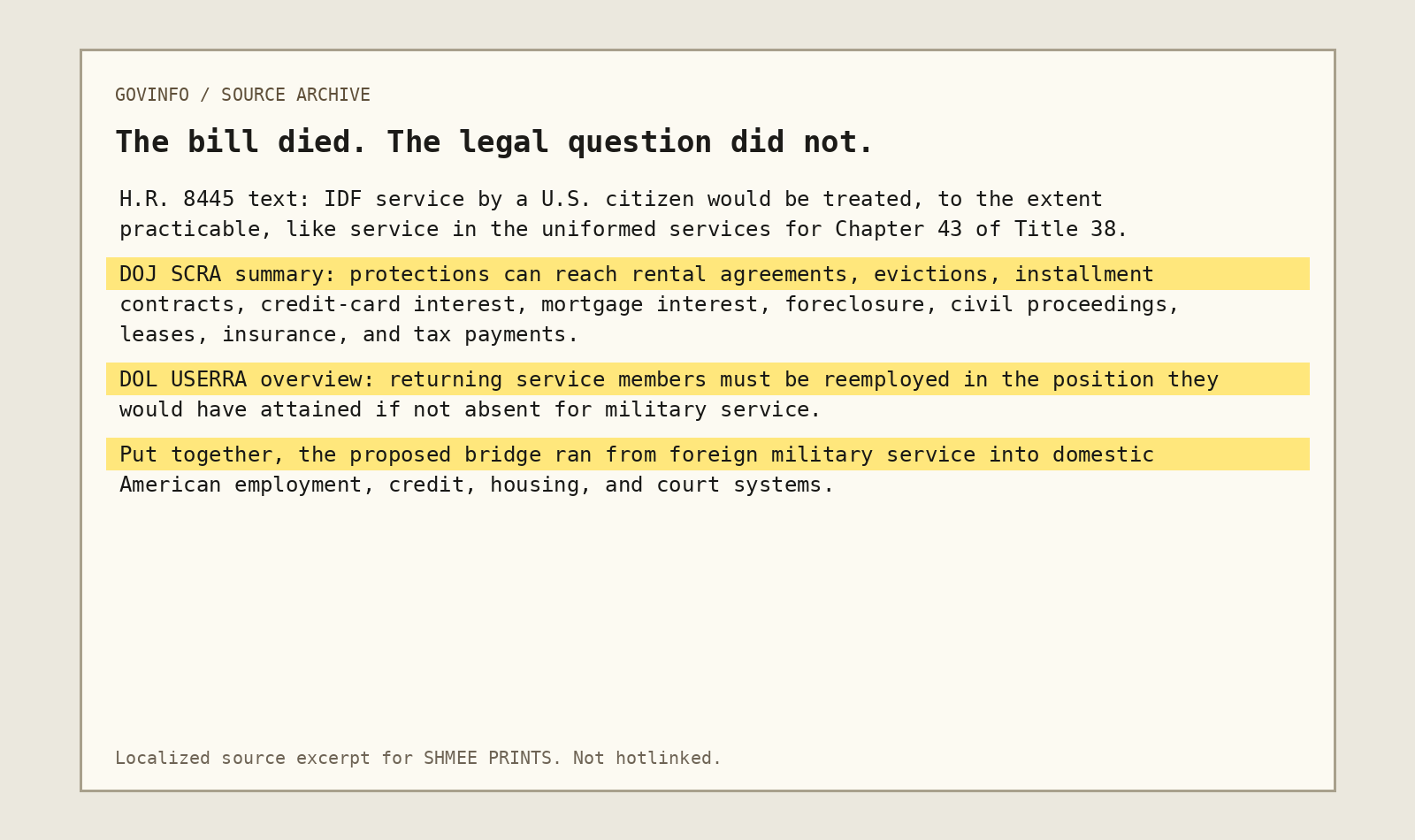
*Side-by-side: H.R. 8445 bill text, DOJ SCRA summary, DOL USERRA page.*
WHAT SURVIVED
The bill text survived.
It says what it says.
The sponsor statement survived.
It says the bill would extend SCRA and USERRA protections to American citizens serving in the IDF.
The legal context survived.
USERRA protects reemployment rights for service in the uniformed services.
SCRA protects servicemembers in civil and financial obligations.
The limitation survived.
H.R. 8445 did not pass before the 118th Congress ended.
The question survived.
Should American law treat service in the Israeli Defense Forces as legally comparable to U.S. uniformed service for certain protections?
H.R. 8445 answered yes.
Congress never made the country debate it.
That is the story.
Not rumor.
Not panic.
Text.